Showing posts with label Peru. Show all posts

Friday, October 22, 2010

Machu Picchu


We've been on a bit of a hiatus from blogging the past couple of weeks, first because we were in San Francisco and then because Paul was busy trying his hand at political blogging as part of the Washington Post pundit contest.

All of which reminded us that before we went on to blog our trip to San Francisco, we still had to finish up the great May trip to Peru and, most especially, the fantastic visit to Machu Picchu.

The trip into Aguas Calientes (the small town outside of Machu Picchu) was the last hike of the trip and a surprising challenging one. We started the day at the last Inn on the trail at about 7000 feet and then hiked up and over a pass at 10,000 feet where we had a fine, but misty view of Machu Picchu in the distance. And then, on the other side, it was down, down, down to the river -- about 3-4,000 feet down on a series of switchbacks. The hike was a true "knee killer." Worse yet, it had rained the day before and the path was all mud. So the hike was just "step, slide, balance; step, slide, balance" for 3 hours nearly straight down. Not fun at all. We arrived in town tired and quite happy to find a room with a strong, hot shower.

The next day was magic. Paul had been skeptical of Machu Picchu from the start. "It's just a bunch of old rocks." Boy was he wrong! The construction at Machu Picchu was stunning -- perfectly cut blocks of stone fitting together seamlessly without mortar. They were so strong that they had withstood the test of time and the shaken of many earthquakes -- something that could not be said for more recent man-made constructions in Lima! And they were so well preserved that, instead of just a jumble of old stones, you got a true sense of the history of the place. One could close ones eyes and almost imagine Incan families wandering about on the mountain top. Late in the day, the sun broke out and we sat basking in the light on one of the agricultural ledges watching the world go by. If you ever get a chance to go do so! Without hesitation.

And there ended our trip, for all intents and purposes. That evening we had a hellish ride back to Cusco. The rains have washed out the train tracks so the train goes only part way and then we got stuffed into a mini-bus for a 2 hour slog at midnight. [As an aside, rumor has it that Rail Peru has no plans to fix the railroad because they are making more money from the insurance payments they get than they would if the restarted operations!]. After another day wandering Cusco and shopping we headed back to Lima and then onto the long flight home to America.

On the whole, a most excellent adventure.

Saturday, July 31, 2010

Our Trip to Peru -- Over the Top

The third day of the hike was, without doubt, one of the most challenging days either of us has ever faced. It began poorly, the night before, when Katy seemed to fall ill. She was suffering from pretty severe sinus pain that we feared was brought on by the altitude and we worried that she would not be able to climb at all. After a phone-call diagnosis by a Peruvian doctor some pain medications and antibiotics were prescribed and we decided to forge ahead.

The first quarter of the day was a steady uphill that seemed to portend well. But then we hit the "Seven Serpents" -- a series of 14 switchbacks that went almost vertically up a steep wall from roughly 14,000 to 15,000 feet. Part of the way up, Katy climbed onto a burro to get to the top. Paul, meanwhile, was suffering shortness of breath and, candidly, a healthy helping of panic at what he was experiencing. The next 45 minutes seemed like an eternity.

Eventually, we made it up the Serpents and then had a well deserved rest. As you can see from this photo, Paul was not particularly happy at this point. But at least we had made it.

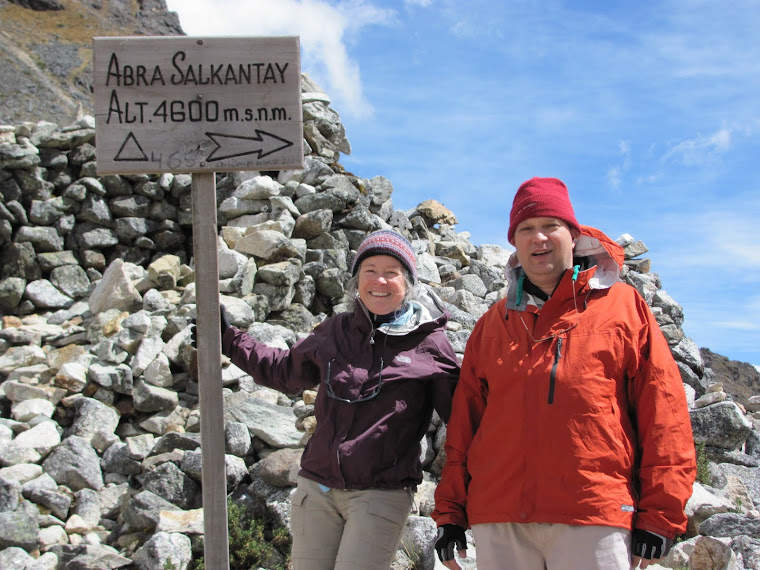
From there it was a relatively short hike (maybe a mile and only 300 more feet up) to the top of the Salkantay pass. There we paused for a well-deserved second rest and some good photos. As you can see, the pass itself is right in the shadow of Mt. Salkantay. The peak behind us is up around 20,000 feet and has been climbed only twice in history (at least as far as anyone knows). To have gotten so close to it was exceedingly difficult and rewarding -- but also amazingly unnerving and challenging.

And so we began a long downhill slog. We still had more than 4 hours to go to the next lodge (overall hike time on this day was 9 hours) and after about 2 hours we stopped for lunch. The most amazing thing happened -- lunch was a hot lunch served in a tent that had been erected for that purpose. Our cook had left the morning lodge after serving us breakfast and literally run ahead of us to set up for lunch. Never had a simple meal tasted so fine! And when we finished the downhill run to the lodge both of us indulged in Pisco Sours to celebrate -- we'd refrained from alcohol until then as a precaution but boy were we ready.

Oddly enough, the second lodge was at almost exactly the same height (12,000 feet) as the one we had slept in the night before -- so our total up and down of 6,600 feet (more than a mile) had gotten us "right back where we started." Except now we were over the pass and past the most challenging part of the hike.


Friday, July 23, 2010

Our Trip to Peru -- The Hike Begins

On Thursday evening we met the others in our hiking group (all Americans, save for two English couples) and our guide, whose given name was (I kid you not) -- Washington. His father had been and admirer of George Washington and named his Peruvian son after the first American President.

Early the next morning we began our trip. Our convoy headed out and the cars let us off about three miles from our first night's lodge. And so we began our walk. Over the next 6 days we would go approximately 39 miles and climb more than 2 miles up and down in elevation change.

The lodges were a chain operated by the Mountain Lodges of Peru. Each one is constructed at distances that are a day's walk from each other. Only the first one is accessible by road. All of the remaining lodges were constructed using materials that were carted in by hand or by burro.

Despite their isolation, the lodges are models of hospitality. They were, in a word, spectacular. When we arrived at the first lodge (pictured above) after a short 3 hour acclimatization hike we were met by staff who gave us a cup of hot tea and a cold towel to wipe off the dust and grime. They took our poles and carefully put them away, and then took our boots away, to be returned to us after they had been cleaned. The next morning they were all carefully laid out by the door.

The other service at the lodge was gracious. Each had a small bar (the local specialty is a drink called the pisco sour which is an absolute killer) and a hot tub. The view on the left is the view from the hot tub at the first lodge of Mt. Salkantay. Our goal, in the hike was to cross the pass below Salkantay's peak -- basically walking through the notch on the left side of the photograph.

After a fine meal (our chef followed us from lodge to lodge and his cooking could easily match up against some of the good restaurants in Washington DC) we retired to bed, there to find that our towels had been twisted into an origami of swans and that two hot water bottles had been put in the bed to keep our feet warm. Talk about being well treated. If you ever want to go on a hike but have a nice place to stay each evening, this is the way to do it.

And so, our trip began. The next day we took a second hike to get the feel for the thin air. The lodge was actually at about 12,200 feet. On the second day we took a short 4 hour hike to a glacial lake up at about 14,000 feet. As we walked we could see the tops of Salkantay and her companion peaks -- all at about 20,000 feet. Remarkably, we could see an Andean Condor circling the top -- at a guess the condor was up around 22,000 feet. Even at that distance and through binoculars you could see how magnificent he was.

The glacial lake was well worth the trip. You could see the moraine left by the glacier and the ice-blue water of the lake was stunning. We found the trip up and back a challenge -- it was not so hard on the legs, for we were well prepared physically, but the thin air was quite a noticeable factor. Still, after two days of preparation work, we thought we were ready to climb across the Salkantay pass.

Wednesday, July 14, 2010

Our Trip to Peru -- Part 2 -- Cusco

Well, we left Lima on a short flight to Cusco. Short it was, but the change was dramatic. Lima is on the coast. While we were there it was cloudy, misty, with a little rain and a chilly 60 degrees. We arrived in Cusco where it was 60 again -- but this time it was bright and sunny and much warmer, though the temperature difference was minimal.

An even bigger difference was, of course, the altitude. Lima is at sea level. Cusco is at 11,000+ feet. We were in Cusco two days early in the hope that we could acclimatize. Fat chance. Making that transition is always going to be hard. It's even harder when you make the transition in less than 90 minutes (which is all the time that the flight took). We spend most of the two days walking around Cusco and it was hard, very hard, especially whenever we had to go uphill.

Even though it was hard to breath, we loved Cusco. It is a delightful city of roughly 400,000 that is one of the most pleasant places we've had a chance to visit in our many trips. The city was bright and clean; and the people were quite friendly.

As you can see, the sky was an almost electric blue color and the Conquistador architecture just seems to fit in the context of the clear skies. This main plaza was literally filled with people, most of whom were doing nothing more than enjoying themselves on the day.

The food in Cusco was, if it is possible, even better than what we had eaten in Lima. We ate, twice at the MAP Cafe -- an al fresco cafe located in the courtyard of the Museo de Arte Precolumbiano. The South American wines were brisk and tasty and I had one of the most unusual dishes I've ever had -- a ceviche that was first cooked in lime (as normal) and then heated up by serving it over a hot stone, so that you had a warmed over ceviche. Add a spicy tomato-based sauce on top and it was just delicious.

But the highlight of our two days in Cusco was definitely the National Pre-school Day parade. Who knew? We simply wandered into it.

It seems that mandatory pre-school education is a relatively new thing in Peru and to celebrate there is, each year at the end of the school year, a national day, complete with parade. We were lucky enough to see the regional parade in Cusco which must have had more than 5000 young children marching. Each and every one of them was, like this angel, in a costume of some sort. They ranged from fantastical characters to recognizable cartoons [Spiderman] to themed ensembles [eco-friendly was very big]. The kids marched up to and then around the big plaza in front of the church, all the while accompanied by marching bands, to the enjoyment and admiration of all the parents and spectators. It was an altogether pleasant surprise and we sat on the steps of the church for quite a while watching the parade go by.

And so our 2 days in Cusco passed quickly. Late on Thursday we met our fellow travellers for a briefing in preparation for the Friday morning departure.

Friday, July 9, 2010

Our Trip to Peru -- Part 1

In May 2010, we traveled to Peru for a two week trip. The core of the trip was a hike in the Andes. But the first couple of days we started off in Lima.

The history of Peru is fascinating -- it is one of those locations where the history is very much alive today. In early 1500s Peru was ruled by the Inca, the Emperor of a huge 10+ million strong empire that stretched from current Ecuador in the north to the northern reaches of current Chile in the south and from the Pacific Ocean over the Andes and down into the Amazon jungle on the eastern slopes. The Incan empire was divided into 4 provinces and the capital was the town of Cusco, up at 11,800 feet in the Andes.

[Neat fact: One of the 4 provinces, the one on the far side of the mountains, was known as the Antisuyu. It is thought that the current name for the mountains "Andes" is derived from the "Antis" -- that is those who lived in Antisuyu on the other side of the range].

In 1532 Francisco Pizarro, a Spanish conquistador, arrived in Peru with 168 men. With the superiority of his arms (rifles, swords, armor and horses for the Spanish vs. cloth and clubs for the Incans) he won a decisive battle at Cajamarca, capturing the Incan emperor Atahualpa. Within a year he had captured Cuzco and installed a puppet Incan ruler Manco (Manco later led a rebellion) and shortly thereafter he founded Lima.

Thus, Lima's central plaza, known as the Plaza d'Armas, is a monument to Catholic domination of region. There are two large churches that dominate the plaza. The magnificence of the structures is, however, perhaps best captured by the intricacy of the filigree work on the woodworking of the buildings. It's almost overwhelming the level of detail -- the picture doesn't do it justice.

One of the highlights of the visit to Lima (and indeed, of the entire visit to Peru) was the quality of the food we eat. In Lima we stayed in a community to the north of the central part of town known as Miraflores. Miraflores is an upscale community filled with coffee shops and a small walking parks. On the edge of the district is a pre-Incan ruin known as Huaca Pucllana, sort of mini-pyramid like structure. We were fortunate enough to dine at a restaurant literally in the shadows of the ruins, called, fittingly enough Restaurant Huaca Pucllana. There we dined on a Peruvian fusion menu that included the native specialty of guinea pig, and included the domestic specialty drink, a pisco sour (absolutely a killer -- don't have more than one).

We also had the chance to visit the Parque del Amore, on the Pacific coast in Miraflores. As you can see, the park is dedicated to the conception of love. This giant statute (see the person at the bottom right for scale) is said to have scandalized the local population when it was first constructed, but by contemporary standards it seems a bit tame. The remainder of the park is a Gaudi-esque construction of tiles with odes to love. Apparently the custom is for local couples who get married to have their names created in tiling and put up on the park benches. It was pretty cute.

On the whole though, we probably spent more time in Lima than we needed too. It is, by and large, simply a big city with the traffic and congestion that attend that status. After two days, we were not unhappy to be heading to our next stop ... Cuzco.

Monday, July 5, 2010

So What =IS= That Photo?

We thought we should explain what that photo is that is at the top of our blog. In May, we went on a hike in Peru up into the Andes on the way to Machu Picchu (about which we will have more to say later). Along the way, at the highest point of the hike, we crossed a pass below Mt. Salkantay. The mountain itself is more than 20,000 feet high and has only been climbed twice that anyone knows of. The pass (where this photo was taken) is at 15,300 feet (4,600 meters) and this photo "celebrates" the fact that we got to the top of the pass.